


The pop, the glass and the bottle
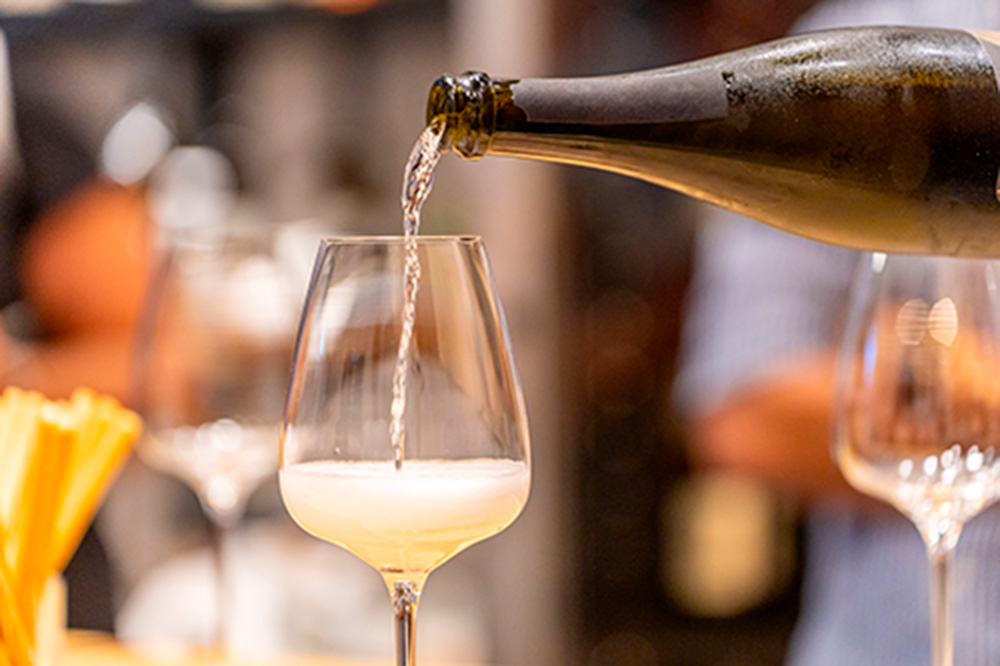
The pop, the glass
and the bottle
Three little curiosities that change everything — and that we think we understand, though they nearly always slip through our fingers.
Champagne that should not go pop
And the rarer kind that is meant to.
There is one small but universal misunderstanding in the world of wine: the dramatic pop of a champagne cork. Cinema has glorified it, sporting victories have sprayed it, and New Year’s Eve has taught us to wait for it. And yet, in Reims and Épernay alike, cellar masters will tell you with a knowing smile: champagne — real champagne — should not pop. It should sigh.
The proper gesture is known as the Queen’s sigh — a phrase often linked to the Marquise de Pompadour. One hand holds the cork, the other turns the bottle — never the other way around — and the cage is eased free until all that escapes is a soft, almost inaudible breath. A whisper, not an explosion.
Why? Because a bottle of champagne holds roughly 6 bars of pressure, around three times the pressure in a car tyre. When the cork shoots out, that pressure is released violently, taking with it some of the wine’s most volatile aromas and a meaningful share of its dissolved carbon dioxide. The wine gains spectacle, but loses finesse: the mousse becomes coarser, the bubbles larger, and the finish shorter.
When pressure is released slowly, the wine keeps its prise de mousse — those fine, steady streams of bubbles that mark long ageing on lees. A cork that bursts out also throws off a tiny droplet of condensed CO₂, carrying aromatic esters with it. Put simply: the louder the opening, the poorer the wine becomes.
And yet — this is where the story becomes truly irresistible — there is one glorious exception. Sabering, the art born in Napoleon’s hussar regiments, involves slicing the neck off the bottle with a saber in one clean motion. The cork departs with a shard of glass, there is a crack of noise, and the room erupts in applause. No one in Champagne finds this absurd: sabering belongs to ceremony, to display, to theatre. It has little to do with tasting. You saber to open an evening, not to open a great vintage.
There is also a category of sparkling wines designed for celebration rather than contemplation: the so-called pop styles, often more generously dosed, made for easy service, cheerful sharing and standing apéritifs. Young Prosecco, festive crémants, lively pét-nats — these wines can withstand a more exuberant gesture without complaint. Their purpose is different. They are meant to be joyful, immediate, a little noisier — and that is perfectly fine.
The right gesture, then, always depends on the wine itself. A Blanc de Blancs aged for ten years deserves the hush of a whisper. A summer Prosecco can live happily with laughter. Elegance lies not in following a rule, but in finding the right match between gesture and wine.
The glass, an extension of the wine itself
Shape, size and thickness: how a 150-gram vessel can transform a drink with centuries of history.
Pour the same wine into three different glasses, taste them blind, and you may well swear they are three entirely different cuvées. It is not illusion — it is geometry at work. A glass can concentrate or disperse aromas, send the wine to one part of the tongue rather than another, sharpen acidity or soften tannins. What Austrian and Czech glassmakers began to theorise in the twentieth century, tasters experience every day: the shape of a glass is part of the shape of flavour.
Three principles guide the choice of a wine glass. Volume determines how much air comes into contact with the wine, and therefore how much oxygenation takes place. The shape of the bowl sends aromas toward the nose — a broad bowl releases them, a narrower one concentrates them. And the fineness of the rim changes the way the wine enters the mouth: a thin rim removes any sense of material between the wine and the palate.
A brief anatomy of the essential glasses
| Shape | Best suited to | What it brings to the tasting |
|---|---|---|
| Burgundy | Pinot Noir, oaked Chardonnay | A broad, generous bowl that narrows at the rim. It gathers delicate aromas and sends the wine toward the front of the palate, preserving finesse while bringing out floral and earthy notes. |
| Bordeaux | Cabernet, Merlot, structured blends | Taller and more upright, with a slightly flared rim. It directs the wine further back in the mouth, softening the impression of tannin and highlighting dark fruit and structure. |
| Universal (INAO) | Technical tastings | An egg-shaped bowl, neither too broad nor too narrow. Neutral and precise, it is ideal for analytical tasting and works well with almost any wine in a professional setting. |
| Flute | Festive sparkling wines | Tall and narrow, it preserves the stream of bubbles and their visual drama. But it also traps aromas, which is why it is better suited to younger sparkling wines than to great vintages. |
| Champagne tulip | Fine champagne, prestige cuvées | Its tulip shape gathers the layered aromas of aged sparkling wines while giving the mousse enough room to breathe. It is the glass preferred by the houses themselves. |
| Liqueur / sherry glass | Sweet wines, fortified wines, spirits | A smaller bowl for smaller pours, usually 4 to 8 cl, allowing concentrated aromas to remain expressive without overwhelming the nose with alcohol. |
Crystal — whether lead crystal or modern barium crystal — can be worked much more finely than ordinary glass. That means a rim of less than a millimetre, with almost no tactile interference at all. Its inner surface, microscopically textured, also encourages both bubble formation and aromatic release. A well-chosen crystal glass is not a luxury object. It is a tool.
Do you really need fifteen different glasses? No. One generous Burgundy glass, one large Bordeaux glass and one champagne tulip will cover ninety percent of situations. Everything beyond that belongs to refinement.
And what about plastic glasses?
For years, the plastic wine glass was the very symbol of oenological sacrilege — clumsy material, lingering odour, thick rim. A new generation of producers, especially in Scandinavia and France, has set out to overturn that prejudice.
Today there are glasses made from Tritan™ and copolyester that come surprisingly close to the transparency of crystal, survive the dishwasher, withstand knocks, and remain almost aromatically neutral. Brands such as Govino, Koziol, and even certain lines inspired by the world of fine stemware have helped make the idea more credible. Better still, bioplastic options made from sugarcane or corn starch are beginning to appear for professional events. Industrially compostable, they offer a more responsible alternative without entirely sacrificing the tasting experience.
Where do they belong? Picnics, boats, poolsides, festivals, outdoor receptions — anywhere real glass becomes impractical or unsafe. They will never replace fine crystal for a thoughtful tasting, but they do make it possible to serve wine properly in settings where the only alternative used to be a cup that ruined everything.
Three things: absolutely no smell when new — always smell the empty glass before pouring — the thinnest rim possible, ideally under 2 mm, and a bowl shape that respects the classic codes of wine service. Anything below that is no longer a wine glass, only a container.
Bottle formats, or the secret geography of the bottle
Why the same wine is never quite the same depending on the size of the bottle it comes in.
When we picture a wine bottle, what usually comes to mind is the classic 75 cl format — the standard from Bordeaux to Barolo. And yet the world of wine contains a whole library of bottle sizes, each with its own name, often biblical, and each capable of influencing the ageing of the wine inside in ways science only began to understand toward the end of the twentieth century.
The principle is simple, but its effects are profound: the larger the format, the more slowly the wine evolves. In a magnum, the ratio between the surface of air contact at the cork and the total volume of liquid is far lower than in a standard bottle. The wine breathes less, oxidises more slowly, and develops tertiary notes with greater patience. A fine wine aged in magnum tends to age more gracefully than the same wine in bottle. For that reason, magnums have long held a particular fascination for collectors.
The bestiary of bottle sizes, from miniature to monumental
- Piccolo / Quarter 20 cl A single glass, served individually. Most often seen with champagne for brunches or travel service.
- Half bottle 37.5 cl The restaurant format for two, or for a solo dessert wine. It evolves faster than a standard bottle.
- Bottle 75 cl The universal standard, roughly six glasses. Its silhouette changes by region: the high-shouldered Bordeaux bottle, the sloping Burgundy bottle, the slender Alsace flute, or the Jura clavelin at 62 cl.
- Magnum 1.5 L Two bottles in one. The preferred format for ageing and festive tables alike. In Champagne, it is often considered the ideal size.
- Jeroboam 3 L (Champagne) / 4.5 L (Bordeaux) The first of the large biblical formats. Depending on the region, it holds the equivalent of four to six bottles. Part cellar treasure, part ceremonial object.
- Rehoboam 4.5 L Six bottles. Mostly associated with Champagne and rarer elsewhere. A true collector’s piece.
- Methuselah / Imperial 6 L Eight bottles. Known as “Methuselah” in Champagne and Burgundy, and “Imperial” in Bordeaux. Made for grand dinners and serious cellars.
- Salmanazar 9 L Twelve bottles — an entire case. It usually takes two people to serve it properly.
- Balthazar 12 L Sixteen bottles. Rare, ceremonial and undeniably spectacular.
- Nebuchadnezzar 15 L Twenty bottles. A giant at the table, often made to order for weddings or celebratory vintages.
- Solomon / Melchior 18 L Twenty-four bottles. Exceptionally rare, and mostly confined to a small number of Champagne houses.
- Melchizedek / Primat 27 to 30 L Thirty-six to forty bottles. The largest commercial format, found almost exclusively in Champagne — part living object, part museum piece.
Beyond size, the shape of the bottle tells its own story of place. The Bordeaux bottle, with its marked shoulders, was designed to hold back sediment when great red wines are poured. The Burgundy bottle, rounder and softer in line, reflects the work of seventeenth-century glassmakers who had not yet mastered sharply defined shoulders. And the Jura clavelin, at 62 cl, mirrors the amount of wine left from one litre after six years and three months of ageing under voile — a bottle whose very capacity tells the story of a method.
A wine is never entirely on its own. It is served through a gesture, expressed through a glass, and held in a bottle whose size can shape its future. These three objects — cork, glass and bottle — form the backstage of pleasure. To ignore them is to miss half the story of wine. To understand them is to discover, within every tasting, a new room in a house one thought one already knew.
See you soon for the next curiosity.


